
TLDR

Montmartre is the hilltop neighborhood in Paris’s 18th arrondissement, crowned by the white-domed Basilica of Sacre-Coeur. Entry to the basilica is free. The streets below are filled with artists, old-world cafes, and quieter lanes that still feel like a village. It’s one of the most visited parts of Paris for good reason, but timing matters. Go early, watch for scams on the steps, and explore past the main square.
Insider Tip
Arrive before 10am. By mid-morning, the steps below Sacre-Coeur are packed and bracelet scammers are out in force. Early morning gives you the basilica nearly to yourself, better photos, and a much calmer walk through the side streets.
Planning your stay? Check current rates at Adriatic Paris Hotel, a convenient base for exploring Paris.
Sacre-Coeur: The Basilica on the Hill
The Basilique du Sacre-Coeur sits at the highest point in Paris, 130 meters above sea level. The Romano-Byzantine church was completed in 1914 and has been a landmark of the Paris skyline since. The white stone actually gets whiter over time. It reacts with rainwater to produce a natural bleaching mineral called calcite.
Entry to the basilica is free. The interior is dim and reverent, with one of the largest mosaic ceilings in the world covering the apse. Photography is not allowed inside. Services run throughout the day, so expect quiet periods where talking is discouraged.
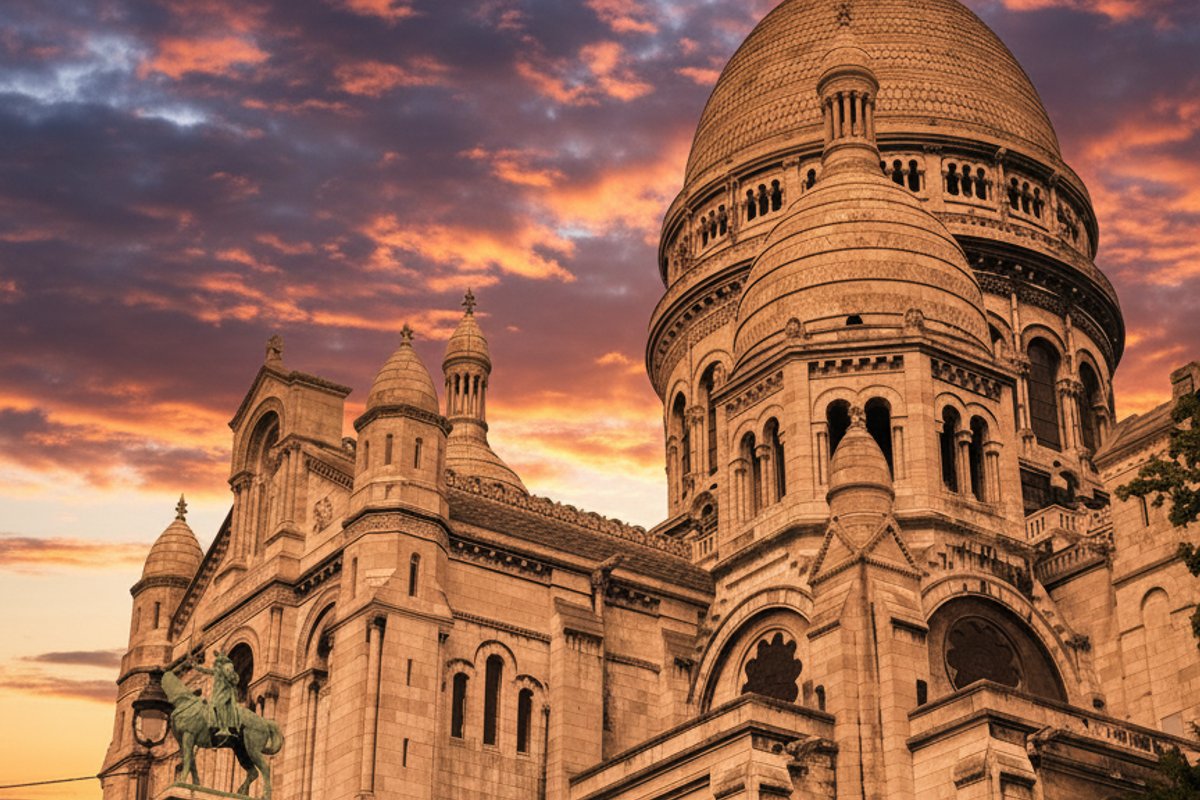

For the best views, pay the roughly 7 euros to climb the dome. It’s 300 narrow, spiraling steps with no elevator. The reward is a 360-degree panorama of Paris that stretches up to 50 kilometers on a clear day. On most visits, you can pick out the Eiffel Tower, Les Invalides, Notre-Dame, and La Defense from up top.
The steps below the basilica face south over Paris. This is where locals and visitors sit at sunset with a bottle of wine and watch the city light up. It’s one of the best free experiences in Paris, but it’s also where you need to keep your guard up. More on that below.
Official site: sacre-coeur-montmartre.com
Planning a trip to Paris?
Our hotel near Gare de Lyon connects to Montmartre in about 30 minutes by metro. Check availability with free cancellation.
Check Available RoomsWe may earn a small commission if you book through this link. It doesn’t cost you anything extra.
Walking Montmartre: Beyond the Postcard
Most visitors take the funicular or stairs up to Sacre-Coeur, snap a few photos, and leave. That means they miss the actual neighborhood, which is the reason people fell in love with this place to begin with.
Montmartre was a village outside Paris until 1860. It still feels like one. The streets are narrow and hilly, with ivy-covered walls, old lampposts, and small squares that open up between rows of shuttered houses. Artists like Renoir, Toulouse-Lautrec, Modigliani, and Picasso lived and worked here. That creative history still shapes the atmosphere.
Start at Place des Abbesses, near the metro station of the same name. This is where you’ll find Le Mur des Je t’aime (The Wall of Love), a 40-square-meter wall covered in “I love you” written in 250 languages. It’s in a small garden called Square Jehan Rictus, tucked just off the square. Free to visit and rarely crowded in the morning.
From Abbesses, walk uphill along Rue Lepic. This is one of the liveliest streets in Montmartre. Halfway up you’ll pass Cafe des Deux Moulins, the cafe from the film Amelie. It’s a working cafe with reasonable prices. Worth stopping in for a coffee just to see the interior, which hasn’t changed much since the film.
Higher up Rue Lepic, the crowds thin out. You’ll pass bakeries, small grocers, and the kind of quiet residential streets that make Montmartre feel separate from the rest of Paris.
What Guests Say About Staying in Paris
Guests rate it 8.7/10 on Booking.com from 4569 reviews.
Spacious room, rare for the city. Great location near public transportation. Friendly and helpful staff.
Place du Tertre: The Artist Square
Place du Tertre is the small square near the top of Montmartre that’s been home to street artists and portrait painters for over a century. Today it’s tourist-heavy. Painters set up easels and sell portraits, caricatures, and landscapes. Restaurants with terraces line the edges.
Is it worth visiting? Yes, but manage your expectations. The square is small, crowded by midday, and the restaurant prices are inflated. Walk through, watch the artists work, and maybe sit for a portrait if that appeals to you. But eat somewhere else. The side streets one block away have better food at lower prices.
Just west of Place du Tertre, look for Clos Montmartre, one of the last remaining vineyards in Paris. It produces about 500 bottles a year. The vineyard is not open to the public except during the Fete des Vendanges harvest festival in October, but you can see it clearly from the fence along Rue des Saules. It’s a strange and charming sight: grapevines growing on a hillside in the middle of one of the world’s biggest cities.
“The stay here was really great, loved the hotel, it was fairly clean with perfect location.”
Moulin Rouge and Lower Montmartre
The Moulin Rouge sits at the base of Montmartre on Boulevard de Clichy, near the Blanche metro station. The red windmill on the roof is one of the most photographed landmarks in Paris. It’s been running cabaret shows since 1889.
Shows start from around 87 euros and sell out well in advance. The dinner-and-show packages are pricier but include champagne and a multi-course meal. Even if you don’t go inside, the exterior is worth seeing, especially at night when the neon lights up.
The area around Moulin Rouge along Boulevard de Clichy is Paris’s red-light district. It’s safe to walk through, but the atmosphere is very different from the hilltop streets above. Sex shops and tourist traps line the boulevard alongside legitimate restaurants and theaters. It’s busy and well-lit at night, with plenty of foot traffic.
Where to Eat in Montmartre
Avoid the restaurants on Place du Tertre. They survive on foot traffic, not quality. Instead, head to the side streets where locals eat.
Cafe des Deux Moulins (15 Rue Lepic) is the Amelie cafe. The food is standard French cafe fare: croque monsieur, onion soup, salads. Prices are fair for the area. The real draw is the atmosphere and the film connection.
Le Coq Rico (98 Rue Lepic) is a proper sit-down restaurant that specializes in rotisserie chicken from high-quality French farms. It’s a step up in price but the food is genuinely good. Reservations recommended for dinner.
Le Consulat (18 Rue Norvins) is one of the most photographed buildings in Montmartre. Corner location, classic Parisian facade, checkered curtains. The food is decent bistro fare and the terrace is a pleasant spot if you can grab a table.
For something quick, the bakeries along Rue Lepic and Rue des Abbesses sell fresh bread, pastries, and sandwiches. Grab a baguette and eat it on the steps of Sacre-Coeur with a view of the city. That’s a better meal than most sit-down options near the tourist circuit.
Getting to Montmartre from Gare de Lyon
The most direct route from our hotel near Gare de Lyon takes about 30 minutes by metro. Take Line 1 from Gare de Lyon to Concorde, then transfer to Line 12 and ride it to Abbesses. That drops you right in the heart of lower Montmartre, a short uphill walk from everything.
Two metro stations serve Montmartre directly:
Anvers (Line 2) puts you at the base of the hill, near the carousel and the bottom of the steps up to Sacre-Coeur. This is the most common approach. From here you can either walk up the stairs from Place Saint-Pierre or take the funicular.
Abbesses (Line 12) is deeper into the neighborhood and closer to Place du Tertre, the Wall of Love, and the quieter streets. It’s also one of the deepest metro stations in Paris. Be prepared for a long spiral staircase or a slow elevator to reach street level.
The funicular runs from Place Saint-Pierre to the top of the hill next to Sacre-Coeur. It costs 2 metro tickets (or is included with a Navigo pass). The ride takes about 90 seconds and saves you the steep staircase, which has over 200 steps.
For more on getting around Paris from this area, see our Gare de Lyon neighborhood guide.
Scam Warnings: What to Watch For
Montmartre has more petty scams than most parts of Paris. None of them are dangerous, but they’re annoying and can cost you money if you’re not expecting them.
Bracelet scammers on the Sacre-Coeur steps. This is the big one. Men approach you, often in a friendly way, and try to tie a woven bracelet around your wrist. Once it’s on, they demand payment. The technique is to grab your hand or wrist while talking to you. Pull your hand back, say nothing, and keep walking. Do not engage in conversation. Do not let them touch your hand.
Three-card monte games operate on the streets around Sacre-Coeur and along Boulevard de Clichy. The players in the crowd are part of the scam. You will not win. Walk past without stopping.
Clipboard petition signers approach with a clipboard asking if you speak English. Once you sign, they ask for a donation. While you’re distracted, a partner may try to pick your pocket. Just shake your head and keep moving.
These scams thin out dramatically before 10am and on the side streets away from Sacre-Coeur. Another reason to go early. For a full breakdown of staying safe in Paris, read our practical safety guide.
Best Time to Visit Montmartre
Early morning, before 10am, is the best window. The streets are quiet, the light is soft, and the basilica is nearly empty. You can actually hear birds in the side streets, which feels impossible by noon when the tour groups arrive.
Evening is the second-best option. The sunset views from the Sacre-Coeur steps are worth building your day around. The sky over Paris turns gold and pink, and you can see the Eiffel Tower sparkle on the hour after dark. Bring a bottle of wine from a nearby shop and join the locals on the grass. The atmosphere is relaxed and social.
Midday between 11am and 4pm is the worst time. Tour buses unload at the bottom of the hill, the steps are shoulder-to-shoulder, and Place du Tertre becomes difficult to move through. If this is your only option, focus on the quieter streets east of the square, around Rue Cortot and Rue de l’Abreuvoir.
For more ideas on how to spend your time in the city, see our guide to top attractions in Paris.
See What Hotel Adriatic Looks Like



Photos from Booking.com. We may earn a small commission if you book through this link.
Stay Near Gare de Lyon, Reach All of Paris
Montmartre is 30 minutes by metro from our hotel. So is the Louvre, the Marais, and the Eiffel Tower. The 12th arrondissement gives you a residential base with easy connections to everything. Find a room with free cancellation and plan from there.
Check Available RoomsWe may earn a small commission if you book through this link. It doesn’t cost you anything extra.
The official Paris tourism board at parisjetaime.com has up-to-date event listings, seasonal guides, and transport information.
“Everything was great, it had very good wifi, no complains at all. The buffet breakfast was delicious.”
Frequently Asked Questions
Is Sacre-Coeur free to visit?
Yes. Entry to the Basilica of Sacre-Coeur is free. You can walk in during opening hours without a ticket. If you want to climb the dome for panoramic views of Paris, that costs roughly 7 euros. The dome climb is 300 steps with no elevator.
How do I get to Montmartre from Gare de Lyon?
Take Metro Line 1 from Gare de Lyon to Concorde, then transfer to Line 12 and ride to Abbesses. The whole journey takes about 30 minutes. From Abbesses you’re a short uphill walk to Sacre-Coeur and Place du Tertre.
What is the best time to visit Montmartre?
Early morning before 10am for the fewest crowds and a peaceful walk. Evening is also good, especially for sunset views from the Sacre-Coeur steps. Avoid midday between 11am and 4pm when tour groups are at their peak.
Are there scams in Montmartre?
Yes. The most common is the bracelet scam on the Sacre-Coeur steps, where someone ties a bracelet on your wrist and demands payment. Pull your hand back and keep walking. Also watch for three-card monte games and clipboard petition signers. These scams are less common before 10am and on the quieter side streets.
Is Moulin Rouge worth visiting?
The exterior with its red windmill is worth seeing, especially lit up at night. Shows start from about 87 euros and sell out in advance. Even if you skip the show, walking past on Boulevard de Clichy is a classic Paris experience. The nearest metro is Blanche on Line 2.
Should I take the funicular or walk up to Sacre-Coeur?
Either works. The funicular costs 2 metro tickets (or is free with a Navigo pass) and takes about 90 seconds. The staircase from Place Saint-Pierre has over 200 steps. If you have mobility concerns or just want to save your energy, take the funicular. If you want the classic approach with views at every turn, walk up.
What is the Wall of Love in Montmartre?
Le Mur des Je t’aime is a 40-square-meter wall covered in “I love you” written in 250 languages. It’s in a small garden called Square Jehan Rictus at Place des Abbesses. Free to visit and usually uncrowded in the morning. It’s a short walk from the Abbesses metro station.
Can you visit the Montmartre vineyard?
Clos Montmartre is one of the last vineyards in Paris but it’s not open to the public except during the Fete des Vendanges harvest festival in October. You can see it clearly from the fence along Rue des Saules year-round. It produces about 500 bottles per year.
Planning a Stay in Paris?
Guests rate Adriatic Paris Hotel 8.7/10 on Booking.com from 4569 reviews. Check prices and availability for Adriatic Paris Hotel on Booking.com, or compare other places to stay nearby.
Check AvailabilityWe may earn a small commission if you book through this link. It does not cost you anything extra.
Staying at Adriatic Paris Hotel? Browse rooms, facilities and more local guides.
Back to Adriatic Paris Hotel